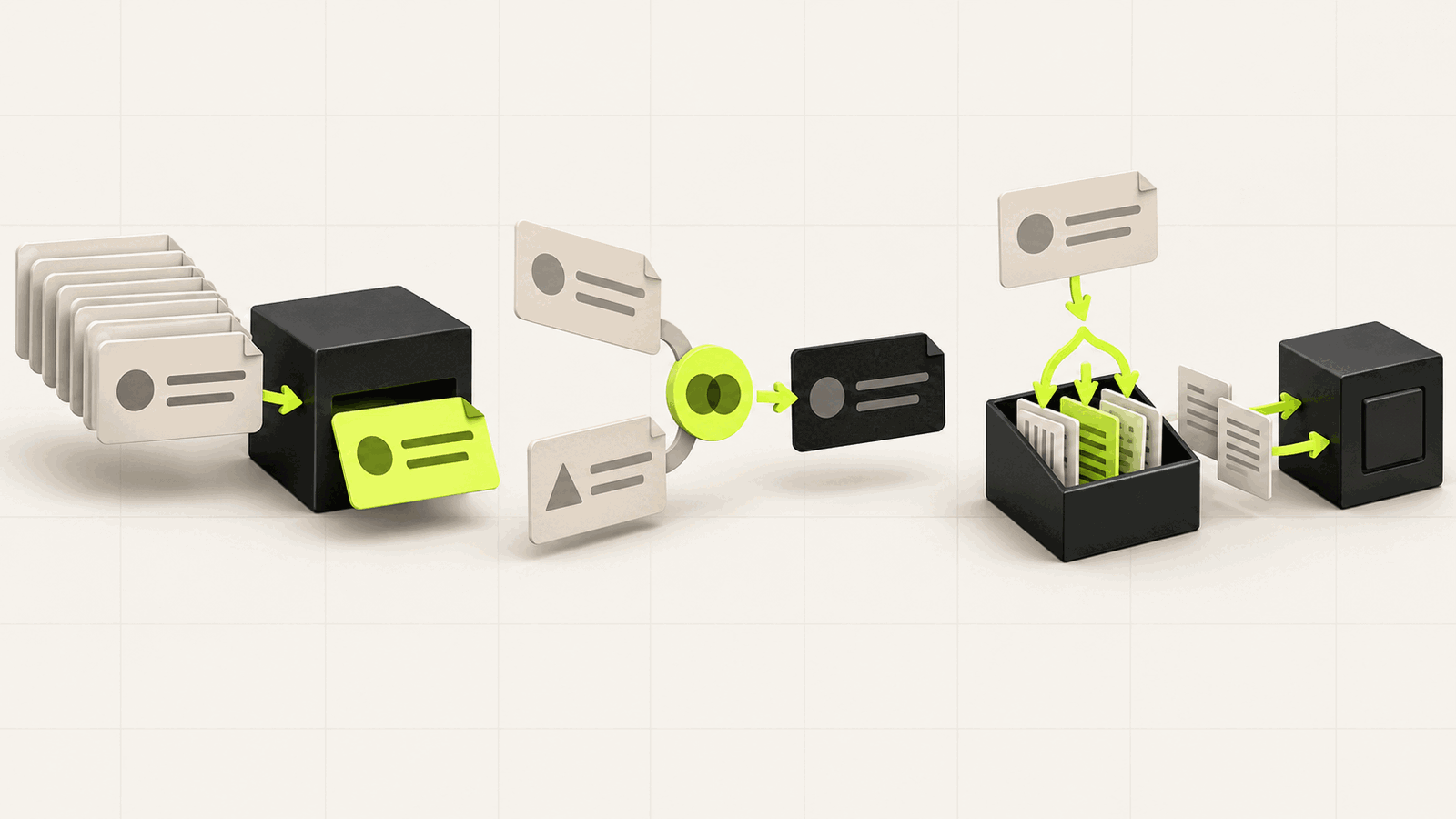
Prompt caching, semantic caching and retrieval-augmented generation (RAG) solve three different problems. Prompt caching reuses model work for an identical input prefix. Semantic caching can return a stored answer for a new question that means roughly the same thing. RAG searches a knowledge source and gives the retrieved material to the model before it writes an answer.
They can reduce cost or improve answers, but they are not interchangeable. The right choice depends on whether you need to reuse computation, reuse a response or retrieve evidence.
The difference in one table
| Mechanism | What it reuses | Match rule | Does the model run? | Main benefit | Main failure risk |
|---|---|---|---|---|---|
| Prompt caching | Processed state for an input prefix | Exact eligible prefix | Yes, for new input and output | Lower input cost and time to first token | Expected cache hits miss because the prefix changed |
| Semantic caching | A completed response | Meaning is similar enough | Usually no on a hit | Avoid a repeated model call | A similar question receives an answer that is wrong, stale or from the wrong user context |
| RAG | Relevant source passages | Search relevance | Yes | Ground answers in private or changing data | Retrieval misses the right evidence or supplies misleading context |
That model-call column is the fastest way to separate them. A prompt-cache hit still generates a new answer. A semantic-cache hit normally serves an old answer. RAG retrieves material and then asks the model to generate from it.
Prompt caching reuses model computation
OpenAI describes prompt caching as reuse of the key-value states calculated for an unchanged prefix. If a later request has the same eligible rendered prefix, the model can skip calculating that part again. It still processes new input and generates a new response.
Prompt caching fits workloads with a large stable beginning and a changing end:
- a long system instruction followed by a short user question;
- a fixed tool schema used across many agent turns;
- the same examples or policy block attached to many requests;
- a conversation that keeps earlier messages unchanged and appends a new one.
On supported OpenAI models, caching is enabled by default. The entire rendered prefix matters: model choice, tool definitions, tool order, response format and earlier messages can all affect reuse. Similar wording is not enough.
A successful hit can reduce eligible input cost and the time spent processing input before the first output token. It does not make the answer a stored artifact, does not ground the answer in current documents and does not make output tokens free.
For prices and break-even arithmetic, see our prompt caching cost guide.
Semantic caching reuses a completed answer
A semantic cache stores a question representation, a response and metadata. For a later question, an embedding model represents the new text and the cache compares it with stored questions. If the similarity passes a configured threshold, the application can return the stored response instead of calling the chat model.
Microsoft’s Azure API Management documentation says its semantic cache can return a cached response for identical prompts and for prompts that are similar in meaning even when the text differs. The lookup needs an embeddings backend and an external cache.
That is useful for stable, repetitive questions:
- “How do I reset my password?” and “I forgot my password—what now?”
- several phrasings of the same product-policy question;
- a support bot with a small set of approved responses;
- summaries over an input that is explicitly versioned and unchanged.
It is also a larger correctness decision than prompt caching. The application is deciding that an old response is good enough for a new input. A threshold that is too loose can merge questions that need different answers. A threshold that is too strict produces few hits.
RAG retrieves evidence before generation
RAG is not a response cache. It searches an index or data store for material relevant to the user’s question, adds that material to the prompt, and asks the model to answer from it.
Microsoft Foundry describes the classic sequence as:
- retrieve relevant information;
- augment the prompt with that grounding data;
- generate a response that can include citations.
Use RAG when the answer should depend on private or frequently changing information: product documentation, internal policies, case records, contracts, research notes or a live knowledge base. The purpose is not mainly to avoid a model call. It is to put the right evidence in front of the model at request time.
RAG introduces its own work: document ingestion, chunking, metadata, index updates, retrieval, ranking, prompt assembly and evaluation. A fluent answer is not proof that retrieval worked. You need to inspect whether the retrieved passages were relevant and whether the answer used them faithfully.
Same question, three different actions
Suppose a support assistant receives: “Can I export all project comments?”
With prompt caching, the long support instructions and tool definitions may be reused if their prefix is unchanged. The question is new input, and the model writes a new answer.
With semantic caching, the system may find that an earlier question—“How do I download every comment from a workspace?”—is similar enough. It can return the old response without a new chat-model call.
With RAG, the system searches the current export documentation, retrieves passages about comments and workspace permissions, and places those passages in the model input. The model then writes an answer based on the retrieved version.
Only the RAG path actively looks for current documentation. Only the semantic-cache path can skip generation by serving a completed answer. Only the prompt-cache path reuses internal processing while still producing a fresh response.
When semantic caching becomes dangerous
A semantic cache needs boundaries beyond a similarity score.
User and tenant boundaries
A response generated from one customer’s data must not be returned to another customer. Microsoft’s API Management guidance provides a vary-by mechanism for partitioning cached responses. The same principle applies in any stack: include the tenant, permissions, locale and other security boundaries in the cache key or partition.
Model, prompt and safety versions
A response produced by one model and system prompt may not be valid after a model change, policy update or tool change. Version the cache against those components, or invalidate entries when they change.
Freshness
A cached shipping policy can be correct on Monday and wrong after a Tuesday policy update. Use a time to live, include the knowledge-base version in the cache namespace, or bypass the cache for volatile subjects.
Actions and personalized answers
Do not reuse a response that depends on an account balance, an order state, a medical record, a permission check or another live tool result unless every relevant input is part of the cache boundary. In many cases, those answers should not be semantically cached at all.
How the three can work together
A system can use all three, but order matters.
A practical pipeline is:
- classify whether the question is safe to cache;
- check a tenant- and version-scoped semantic cache;
- on a miss, retrieve current evidence;
- build the prompt with instructions and retrieved passages;
- call the model, benefiting from prompt caching where stable prefixes remain identical;
- validate the response and store it only if the topic is eligible for semantic reuse.
The difficult part is step two. If the semantic cache is checked before RAG, a hit can bypass fresh retrieval. That is acceptable only when the cached response is tied to the current knowledge version or the subject is stable for the entry’s lifetime.
Prompt caching inside a RAG pipeline is also workload-dependent. The system instruction and tool schema can remain stable, but retrieved passages usually change and can disrupt the reusable prefix. Put stable material first when the API and application design allow it, then measure actual cache-read and cache-write tokens rather than assuming a hit.
How to choose
Choose prompt caching when:
- requests share a long exact prefix;
- you still want a new response;
- input processing cost or latency is significant;
- the provider exposes useful hit and token metrics.
Choose semantic caching when:
- many users ask the same stable question in different words;
- returning a stored response is acceptable;
- you can define strict tenant, permission and freshness boundaries;
- you have an evaluation set for similarity thresholds.
Choose RAG when:
- answers must use private or changing information;
- the application should cite or expose its evidence;
- retrieving the right source matters more than skipping a model call;
- you can maintain and evaluate the index.
Choose more than one when each layer has a measured job. Do not add all three because a reference architecture shows all three boxes.
Measure the right thing
Each mechanism needs different metrics.
For prompt caching, record:
- cached-input tokens;
- cache-write tokens;
- ordinary input and output tokens;
- hit rate and time to first token;
- total request cost, not just the cached prefix.
For semantic caching, record:
- hit rate;
- false-hit rate from reviewed samples;
- answer age;
- hits by tenant and policy version;
- backend calls avoided;
- user corrections or escalations after a hit.
For RAG, record:
- retrieval precision and recall on a labeled question set;
- whether the needed passage appeared in the retrieved set;
- groundedness and citation accuracy;
- answer completeness;
- retrieval and generation latency separately.
A high semantic-cache hit rate can be a bad result if the threshold is merging different questions. A low RAG latency can be a bad result if the right document never reaches the model.