A Stripe refund status tells a merchant what the refund record currently reports, not necessarily what the customer can already see on a bank statement. Start with the original payment and the exact refund ID, then inspect the current state, changes and any available tracing reference. Keep that evidence separate from the support message promising to return the money.
Start with the refund record, not the email
Stripe’s refund documentation distinguishes canceling an incomplete payment from refunding a successful one. Card refunds can remain pending when the merchant’s available Stripe balance is insufficient; refunds can also fail.
For a support workflow, retain the original payment ID, refund ID, amount, currency and latest retrieval time. A screenshot or email without those links can be difficult to match to the transaction being discussed.
Consider a hypothetical order with two partial refunds. “The refund succeeded” is ambiguous unless the agent names which refund and amount. A useful case note identifies the individual operation before describing its outcome.
The wider authorization and capture sequence explains the earlier stages. This guide concerns tracking a refund after that payment decision, not choosing whether a customer is entitled to one.
Read creation and later changes separately
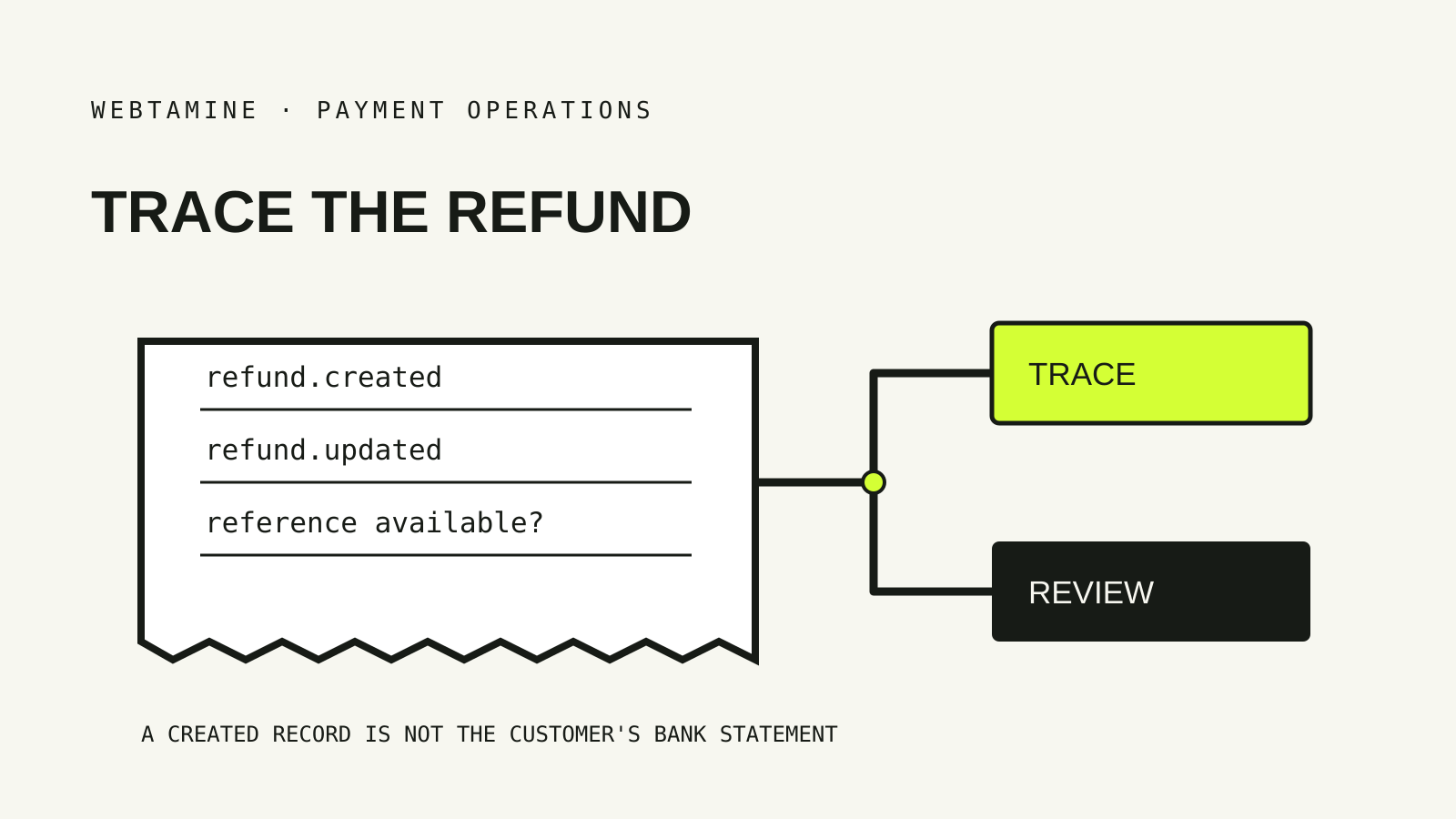
Stripe exposes refund.created, refund.updated and refund.failed events. Its guide recommends verifying webhook signatures and handling refund events; an update can provide tracing details.
Your own support model should distinguish “request recorded,” “latest provider state checked” and “customer’s query resolved.” Those are suggested internal labels, not invented Stripe status values.
A reasonable review sequence is:
- Match the order to its original payment.
- Find the particular refund the customer is asking about.
- Retrieve its current state before explaining an old notification.
- Compare the amount and currency with the request.
- Record the next action and who owns it.
Do not treat an API timeout as permission to start another refund immediately. Reconcile the uncertain operation first. Our guides to webhooks and polling and idempotency keys explain the general recovery pattern.
A missing credit can require a different question
Stripe explains that some early refunds appear as reversals: the original charge disappears rather than producing a separate credit. Its Dashboard can identify this in the refund’s details.
That changes the support question. Instead of asking only “Can you find the credit?”, ask whether the original completed debit remains on the statement. Do not request a full unredacted statement when narrower transaction evidence will answer the question.
An illustrative case note might read: “Customer cannot locate a separate credit. Check the refund details for reversal handling, then confirm the original transaction’s display.” This is a proposed investigation note, not an example from a real customer.
Avoid telling a customer that every missing credit is a reversal. The explanation must come from the particular transaction, not from a convenient general rule.
Use an available reference for tracing
Stripe lists ARN, STAN and RRN as possible card-refund tracing references, with availability depending on the payment chain. An ARN is not available for a reversal.
When a reference exists, copy the value and its type accurately into the support case. Avoid relabeling a merchant’s internal refund ID as an ARN. They identify different things.
A concise handoff should state the refund amount, currency, initiation date, current provider status and the available tracing reference. Keep private payment information inside the authorized support channel.
If a field is absent, say that the reference is not available in the record you inspected. Do not manufacture a number or promise that the bank can trace the payment using any arbitrary order identifier.
Close the case on evidence
Keep a short timeline: request received, operation identified, current state retrieved, customer informed and any escalation assigned. This is an operational recommendation, not a provider settlement guarantee.
If a later update changes the outcome, preserve the earlier observation and add the new one. Overwriting “pending” with “failed” without a timestamp can make it look as though the first support reply ignored information that arrived later.
The same discipline helps a team review its own response quality. A clear case record should let a colleague continue the investigation without asking the customer to repeat everything.
Source
Stripe: Refund and cancel payments, checked October 24, 2026. The case notes and support-control recommendations are illustrative; no customer transactions were accessed or tested.