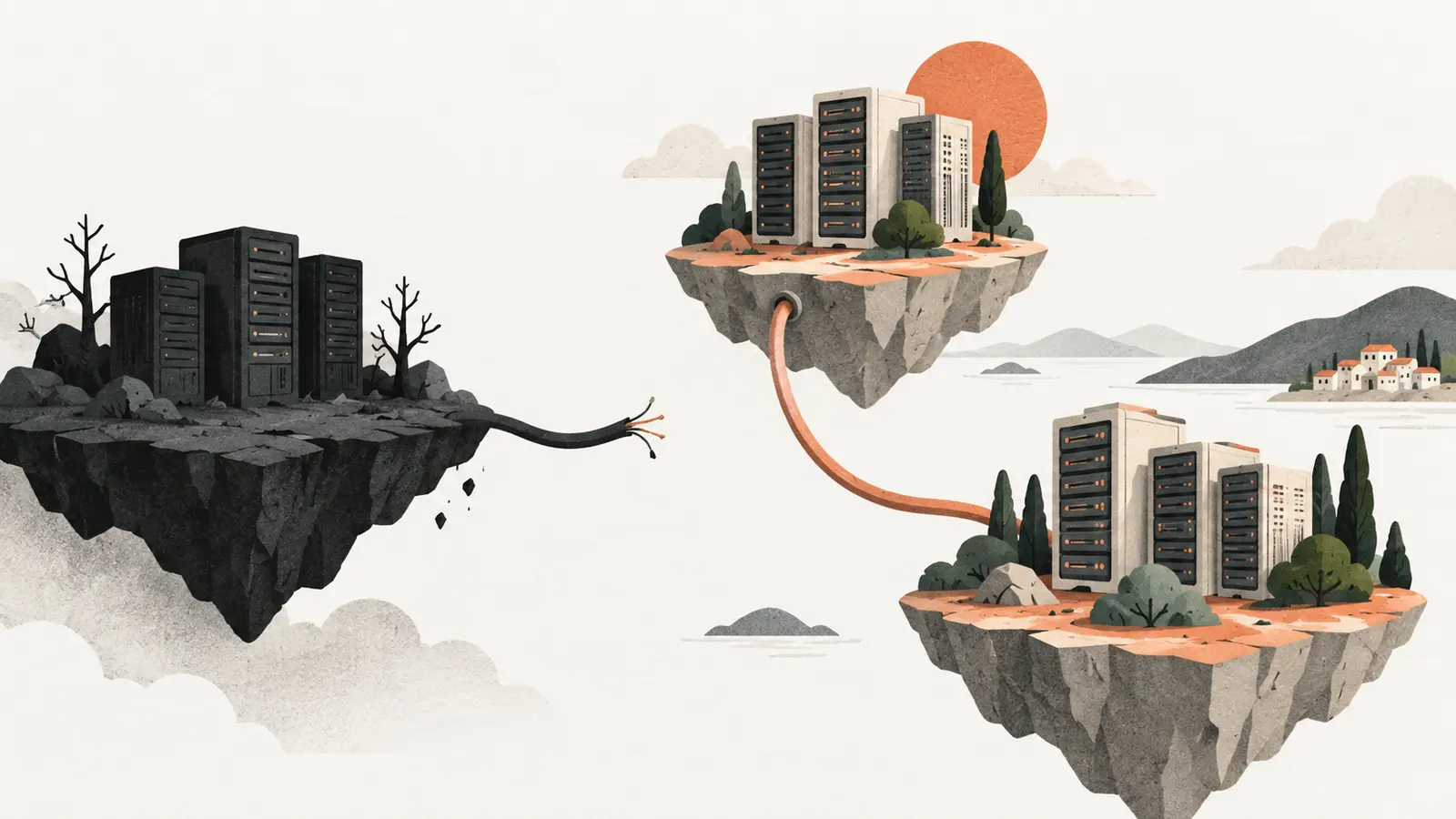
A service has several servers, yet one cloud incident takes it offline. That is not necessarily a contradiction. The servers may depend on the same regional database, identity service, network path or control system.
Redundancy helps when the copies can fail independently and the application can use a surviving copy. Counting machines without tracing their dependencies gives an incomplete picture.
Cloud providers divide infrastructure into regions and availability zones to create boundaries between failures. Applications still have to choose how to use those boundaries and what to do when one is unavailable.
A region contains several failure boundaries
A region is a geographic grouping of cloud infrastructure. Availability zones are separate locations within a region, designed with independent infrastructure and connected networking.
AWS describes its regions as isolated from one another, with multiple availability zones. Its availability-zone documentation explains the physical separation and infrastructure design intended to limit the reach of failures.
Deploying across zones can help an application survive problems affecting one zone. It does not automatically protect against every regional service failure, application bug or shared dependency. The scope of protection depends on the service and configuration.
An application’s own design matters too. If several front-end servers all use one database instance, distributing the front ends does not remove that database dependency.
Data does not appear in another region by default
A second region can provide a recovery location, but it needs the data and configuration required to run the application. Many resources are regional; cross-region copies or replication must be configured where supported.
Replication can reduce recovery time, but it introduces questions about delay and consistency. If the second region is behind the first, moving traffic may expose older data. If both accept writes, the system needs a strategy for conflicting changes.
Backups solve a different problem. They can preserve recoverable history, but restoring a large database and bringing an application online may take time. A backup existing somewhere is not evidence that a complete service can be restored within a particular deadline.
Failover needs more than a healthy server
Traffic must reach the surviving application. That may require a load-balancer change, a routing decision or a DNS update. Clients and intermediate systems can cache information, so a change is not always experienced everywhere at once.
The destination also needs enough capacity. A small standby system may be healthy but unable to handle the full production load. Scaling it during an incident can depend on quotas, available capacity and control-plane services that may themselves be under strain.
Credentials, certificates, secrets and third-party allowlists can become hidden dependencies. A recovery deployment can run correctly and still fail because an external payment service accepts requests only from the original network addresses.
Existing work and new work can behave differently
Cloud systems often separate the processing of normal requests from the controls used to create or change resources. An incident can affect one more than the other.
For example, existing application instances may keep serving requests while launching replacements becomes difficult. Or the application may remain reachable while an essential database or message service is impaired. A status page’s service name is only a starting point for understanding the user’s experience.
This is why incident reports should distinguish observed effects from assumptions about the cause. “Customers could not complete checkout” is an observation. “The entire cloud was down” is a much broader claim that needs evidence.
Recovery objectives describe tolerable loss and delay
Two common planning measures are recovery time objective and recovery point objective. The first concerns the target time to restore service. The second concerns how much recent data loss the recovery plan aims to limit.
They are objectives to design and test against, not guarantees produced by writing the numbers in a document. A service that can tolerate an hour of downtime but no lost transactions has different requirements from a read-only publication that can tolerate a recent content snapshot.
Test the complete path on an appropriate environment: restore data, start dependencies, route traffic and check an actual user operation. A server health endpoint is useful, but it does not prove that a customer can sign in or finish a purchase.
What readers can learn from an outage notice
Look for the affected function, region, time window and recovery status. A provider may resolve its infrastructure issue before every customer application has recovered. Queues, retries and data reconciliation can extend the effect.
Repeatedly retrying a payment or form submission can also create uncertainty about whether an earlier attempt succeeded. Use the service’s transaction history or confirmation record where available before submitting again.
For users who need work to continue without a network service, local-first software can reduce some dependencies. It does not make remote collaboration or cloud-only operations available during an outage. Resilience comes from knowing which work can continue and which dependencies remain.