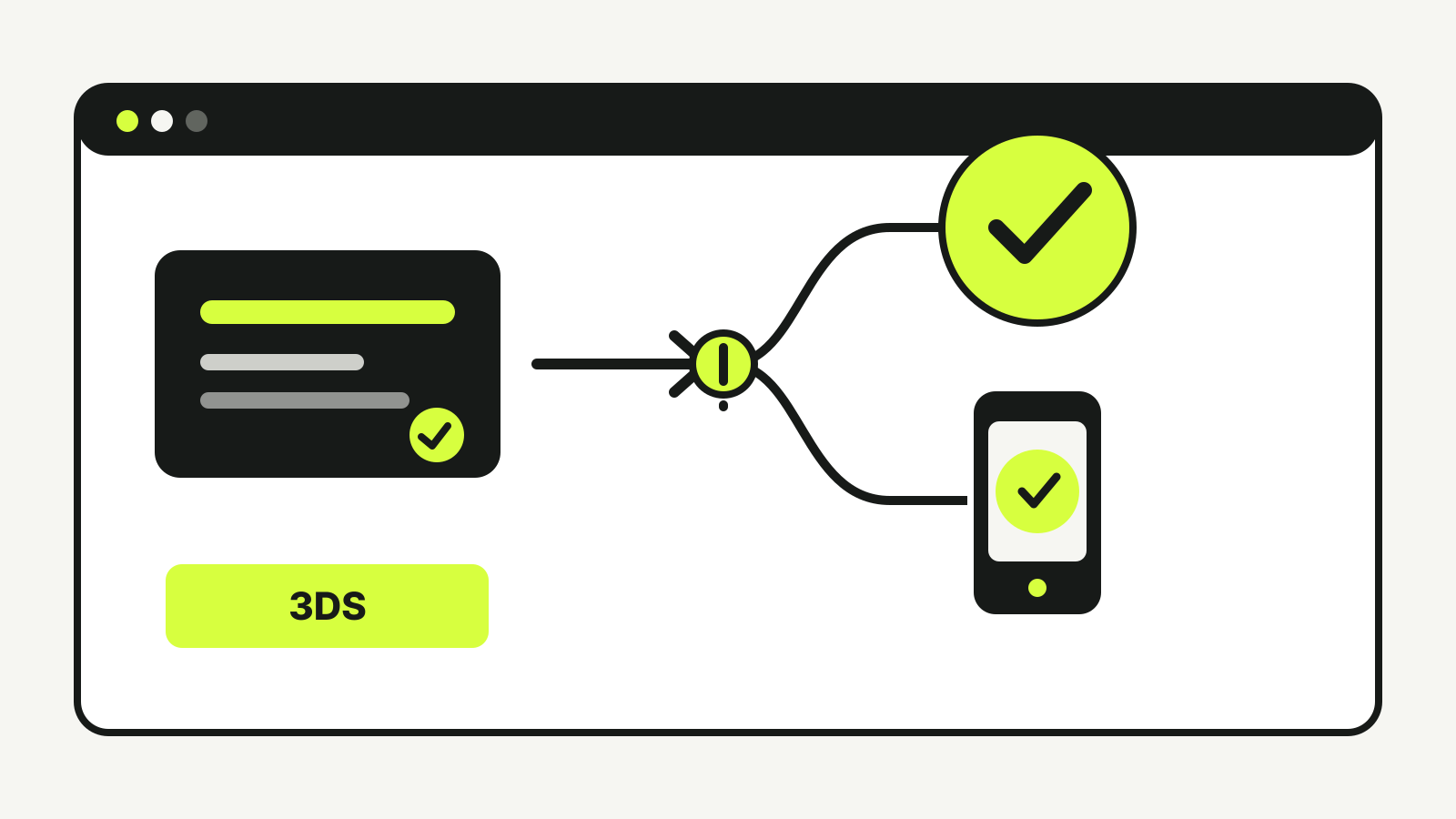
3D Secure frictionless vs challenge is not a choice between using 3DS and skipping it. Both are authentication paths inside the same card-payment protocol. In a frictionless flow, the issuer evaluates the information sent with the purchase and returns an authentication result without asking the shopper to do anything. In a challenge flow, the issuer asks the shopper for an extra step, such as a one-time code or biometric check.
The issuer, not the merchant’s checkout button, makes the final flow decision. A merchant can supply better data and sometimes express a preference, but it should build for either outcome.
What 3D Secure adds to checkout
EMVCo describes EMV 3-D Secure as a way for the merchant and card issuer to exchange messages for cardholder authentication. Those messages can include information about the transaction, payment method and device.
That authentication happens alongside the payment process; it does not replace card authorization. A successful 3DS result says the authentication step reached a supported outcome. The payment can still be declined when the issuer later decides whether to authorize it. Likewise, a checkout must not mark an order paid merely because the bank’s challenge screen closed.
For the next stage, see card authorization vs capture.
Frictionless flow: the issuer decides from data
In a frictionless flow, the issuer evaluates the authentication request without prompting the shopper. The customer may see only a short processing state before checkout continues.
“Frictionless” does not mean that no authentication occurred. It means the protocol completed the authentication path without active input from the cardholder. EMVCo says issuers use transaction, payment-method and device information to assess the purchase. Stripe’s 3DS integration documentation shows the bank assessing the transaction and completing 3DS at that stage when it has enough information.
For merchants, the practical lesson is to send accurate data rather than trying to suppress every prompt. Missing or inconsistent billing details can give the issuer less context. The exact fields and obligations depend on the payment provider and integration, so use the provider’s current schema instead of copying a generic field list.
Challenge flow: the cardholder must respond
A challenge flow asks the cardholder to complete an additional action. EMVCo lists one-time passcodes, knowledge-based questions and biometrics as possible methods. The issuer controls which method appears.
On the web, the challenge may appear in a modal, an embedded frame or a redirect to an issuer-controlled page. In an app, the payment SDK can present a native or web-based authentication view. Stripe notes that the issuing bank controls the web challenge’s fonts and colors. A merchant can choose where the frame appears, but it cannot safely assume the bank’s interface will match the rest of checkout.
A challenge is therefore an external state in the order flow. The customer can succeed, fail, time out, abandon the page or return after the merchant’s first browser request has ended. The integration needs a server-side payment record and a recovery route for every one of those cases.
Side-by-side: what actually changes
| Question | Frictionless flow | Challenge flow |
|---|---|---|
| Does 3DS run? | Yes | Yes |
| Does the shopper actively respond? | Usually no | Yes |
| Who chooses the final path? | The issuer | The issuer |
| What does the merchant show? | Often only a processing state | Issuer-controlled authentication UI |
| Can the payment still fail later? | Yes | Yes |
| What must the integration record? | Authentication result and payment state | Result, return/timeout state and payment state |
The table describes the customer interaction, not a guarantee about authorization, settlement or fraud outcomes.
A preference is not a command
Some payment APIs let a merchant request 3DS or prefer a particular route. Stripe, for example, documents an API preference for a frictionless flow and another for a challenge flow. It also states that the issuer determines the final authentication flow.
That distinction matters in testing. A test environment may reliably show a challenge card, while production issuers decide from their own risk and regulatory logic. Product copy should say “you may be asked to verify” rather than promising that a code always appears.
Regulation can also trigger authentication. Stripe says it automatically initiates 3DS for applicable requirements, issuer soft declines and some risk decisions. It also notes that not every transaction or payment method supports 3DS. The merchant needs a documented fallback for a card that cannot complete the requested authentication.
Treat the result as a state machine
A safe implementation separates authentication from the final payment status. Stripe’s Payment Intents example uses states such as:
requires_actionwhen the customer must complete an additional step;processingwhile the payment continues;requires_payment_methodwhen another payment method or retry may be needed;requires_capturewhen authorization succeeded and separate capture is enabled;succeededwhen the payment completed in that integration.
Those names are Stripe-specific, but the pattern is portable. Store the provider’s payment identifier and latest server-confirmed state. Do not reduce the whole flow to a browser-side challenge_completed=true flag.
The browser redirect is also not the final source of truth. A shopper can close the tab after completing authentication, or the return request can fail while the provider’s state has already changed. Use signed provider events and a retrieval endpoint to reconcile uncertain outcomes. The same reason idempotency keys protect payment retries applies here: a timeout does not prove that nothing happened.
What to log without collecting too much
Operational logs should make a failed checkout explainable without copying sensitive authentication data.
Useful fields include the merchant order ID, provider payment ID, amount and currency, whether 3DS was requested, the reported authentication flow, the result code, the payment status and timestamps for each transition. Keep the provider’s own identifiers so support can reconcile an uncertain case.
Avoid logging one-time codes, full card data or the contents of an issuer’s challenge page. EMVCo notes that consumer data is used for risk evaluation and that merchants and issuers remain responsible for applicable privacy law. More data is not automatically better if it is retained outside the payment system without a defined need.
Design the customer recovery path
A robust checkout answers four awkward questions before launch:
- What does the customer see if the challenge times out?
- Can they resume the same payment rather than create another order?
- How does support check whether authentication succeeded but authorization failed?
- When is it safe to ask for another payment method?
The message should match the known state. “We couldn’t confirm the payment” is safer than “Your bank declined the card” when the integration only knows that a return URL was never reached. Before letting the customer retry, retrieve the provider record and reconcile any late webhook.
For webhook delivery and polling tradeoffs, see webhooks vs polling.